Useful Distraction Techniques for Dementia Caregivers: 8 That Truly Work
When a loved one with dementia becomes upset, frightened, or fixated on something distressing, your first instinct is often to explain or correct. Unfortunately, that rarely works. This is where useful distraction techniques for dementia caregivers come in — a gentler approach that families around the world rely on every day.
Distraction, also called redirection, simply means guiding the person’s attention away from what is upsetting them and toward something calmer or more familiar. It is not a trick, and it is not dishonest. It works because dementia changes how the brain processes stress, and a person in distress often cannot be reasoned out of that feeling — but their focus can be gently shifted.
This guide gives you eight practical techniques, and for each one a real example of how it looks and a common mistake to avoid. At the end, you will find how to adapt these methods to the early, middle, and late stages of dementia, because what works changes as the disease progresses.
Why Distraction Works Better Than Correcting
Agitation is a common part of dementia — by some estimates, more than 80% of people who develop Alzheimer’s eventually become agitated or aggressive at some point. So if you are facing these moments, you are not doing anything wrong, and you are far from alone.
Imagine being told that a memory you feel certain about is wrong. It would feel confusing and upsetting. For a person with dementia, being corrected can feel exactly like that — many times a day. Arguing about facts tends to increase frustration and anxiety, because the person is responding to an emotion, not to logic.
Distraction sidesteps the conflict. One useful approach is to validate the feeling first, then redirect. If the person is anxiously looking for a parent who has long passed away, you might say, “You miss your mother — tell me about her,” and then move toward a photo album. You have not argued, and you have not lied; you have acknowledged the emotion and gently shifted the focus.
8 Distraction Techniques, With Examples and Mistakes to Avoid
1. Play familiar music
Music reaches people with dementia in a way that words often cannot. A favorite song from the person’s younger years can shift a tense mood within moments.
Example: Keep a short playlist of music your loved one has always loved. When tension begins to rise during a difficult task like getting dressed, start the playlist before the moment escalates.
Avoid: Loud or unfamiliar music, or leaving a TV news channel on in the background. The goal is calm and familiar, not more stimulation.
2. Offer a simple, hands-on task
A familiar, repetitive activity can absorb attention and give a quiet sense of purpose. Folding towels, sorting buttons or coins, matching socks, or wiping a table are all gentle options.
Example: If your loved one was a homemaker, a basket of laundry to fold can feel meaningful and calming. If he was an office worker, sorting a stack of papers or coins may work better.
Avoid: Tasks that are too complex for the current stage. If the person struggles and fails, the activity adds frustration instead of removing it.
3. Look through old photographs
Photo albums invite the person into long-term memories, which often stay vivid even when recent memory fades.
Example: Start by naming the people yourself — “Here is your sister Anne at the beach” — rather than asking “Do you know who this is?”
Avoid: Turning it into a memory test. A question the person cannot answer can feel like an exam and increase anxiety.
4. Change the room or step outside
Sometimes the simplest redirection is a change of scenery. A short walk, a few minutes on a porch, or moving to a different room can interrupt building agitation.
Example: Outdoor time is especially helpful in the late afternoon, when mood changes often intensify. A few minutes in the yard can reset a restless mood.
Avoid: Rushing the person or making the change feel like being ordered around. Invite gently: “Let’s go look at the garden.”
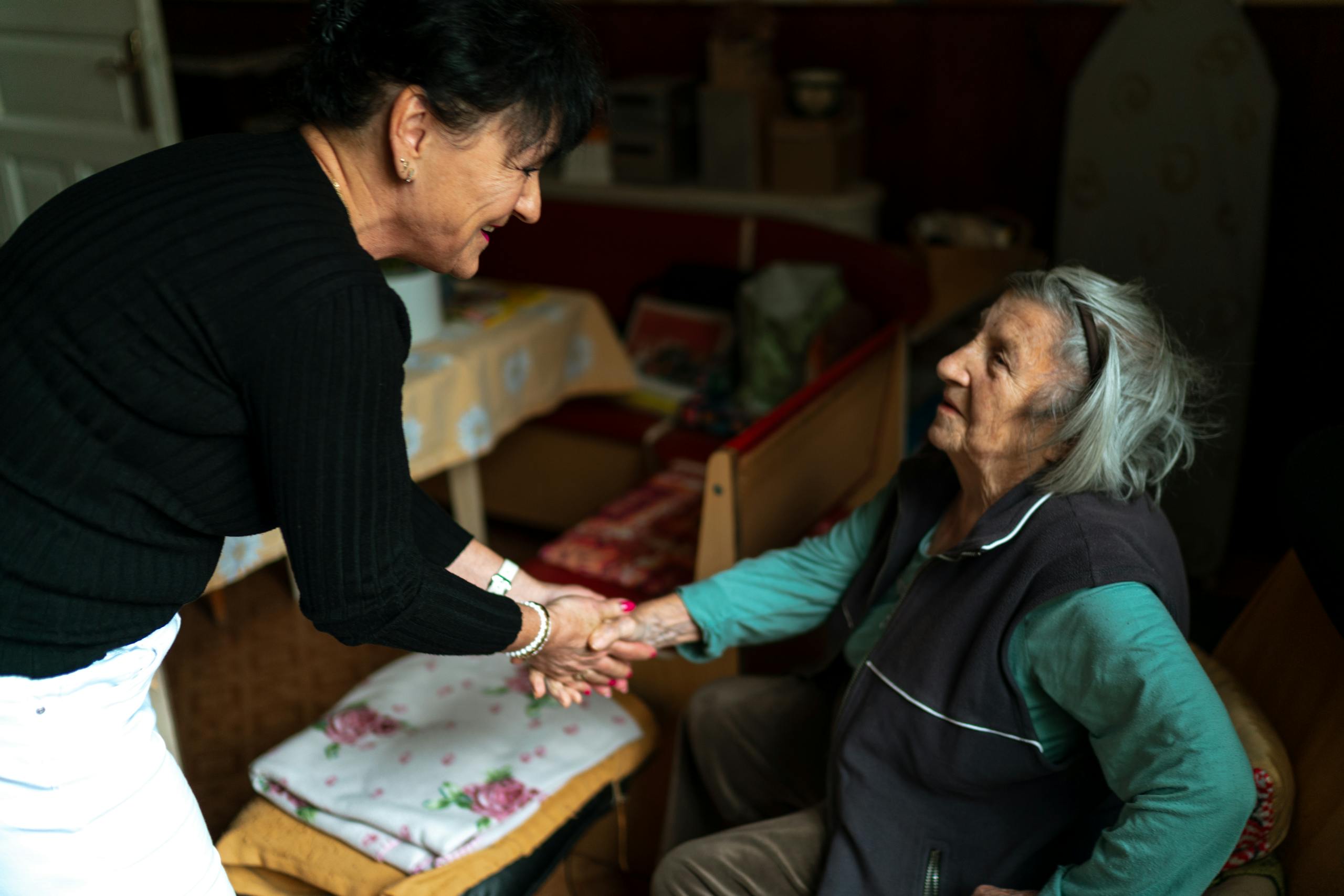
5. Use gentle, comforting touch
For many people, a held hand, a hand massage with lotion, or a soft blanket offers reassurance that words cannot.
Example: Offer your hand and watch the response. If the person leans in or relaxes, touch is welcome and can calm distress quickly.
Avoid: Touch from behind or without warning, which can startle. Always approach where the person can see you.
6. Shift the conversation to the past
Asking about a childhood home, a first job, or a favorite tradition draws the person toward comfortable, well-worn memories.
Example: “What did your mother used to cook on Sundays?” invites a warm memory without requiring recent recall.
Avoid: Questions about recent events (“What did you have for lunch?”), which highlight memory loss and can cause distress.
7. Try calming scents
Some caregivers find that gentle scents such as lavender help create a soothing atmosphere. It is worth being clear about the evidence here: scientific studies have not found strong proof that aromatherapy treats dementia or reliably reduces agitation. Still, a pleasant, familiar smell may simply make a room feel more comforting, and for that reason some families like to keep it in their toolkit. Treat it as a gentle comfort, not a guaranteed solution.
Example: Place a few drops of lavender oil on a tissue nearby, or use a scented sachet. Lemon balm and chamomile are other gentle options some caregivers try.
Avoid: Applying essential oils directly to the skin, and using any scent before checking the person finds it pleasant. Never rely on a scent in place of checking for a real cause of distress.
8. Start a new activity yourself
If a particular task is causing distress, simply begin something else nearby. Often the person drifts toward the new activity and leaves the upsetting one behind.
Example: Instead of insisting the person stop, sit down nearby and start setting out a snack, or begin folding laundry. The new activity quietly invites them in.
Avoid: Announcing “Stop that, do this instead.” The redirection works best when it feels natural, not like an instruction.
How to Adapt These Techniques to Each Stage
Dementia changes over time, and so should your approach. The same technique often needs to be simpler as the disease progresses.
If you’re not sure which stage your loved one is in, our guide to the 7 stages of Alzheimer’s explains what to expect.
Early stage
The person can still hold a conversation and manage relatively complex activities. Conversation-based redirection, puzzles, familiar hobbies, cooking a known recipe, and social outings all tend to work well. You can rely more on words and shared activities.
Middle stage
This is often the longest stage. Complex tasks become harder, so simpler, structured activities work better — sorting, guided crafts, music, and photo albums. Validating the emotion and then redirecting is especially effective here. Keep instructions short and one step at a time.
Late stage
Words and tasks become less reachable, and sensory approaches matter most. Gentle music, soft textures, a warm blanket, calm scents, and gentle touch offer comfort when conversation no longer can. The goal shifts from activity to simple, reassuring connection.
How to Make Distraction Work
A few principles help these techniques land. Stay calm yourself — your tone and body language matter as much as the activity. Acknowledge the feeling before redirecting. And act early: distraction works best at the first signs of agitation — restlessness, repeated questions, a furrowed brow — before distress peaks. Over time you will learn to recognize those early signs and step in sooner.
When Distraction Is Not Enough
Distraction is a tool for everyday difficult moments — it is not a solution for everything. If a person is frequently agitated, aggressive, or distressed, that is worth discussing with their doctor, as an unmet need, pain, or a medication issue may be behind it. Sudden changes in behavior in particular should always be checked by a medical professional, since they can signal infection or another treatable cause.
Caring for someone with dementia is demanding work, and no technique replaces support for you, the caregiver. Reaching for distraction instead of argument is not only easier on your loved one — it is easier on you.